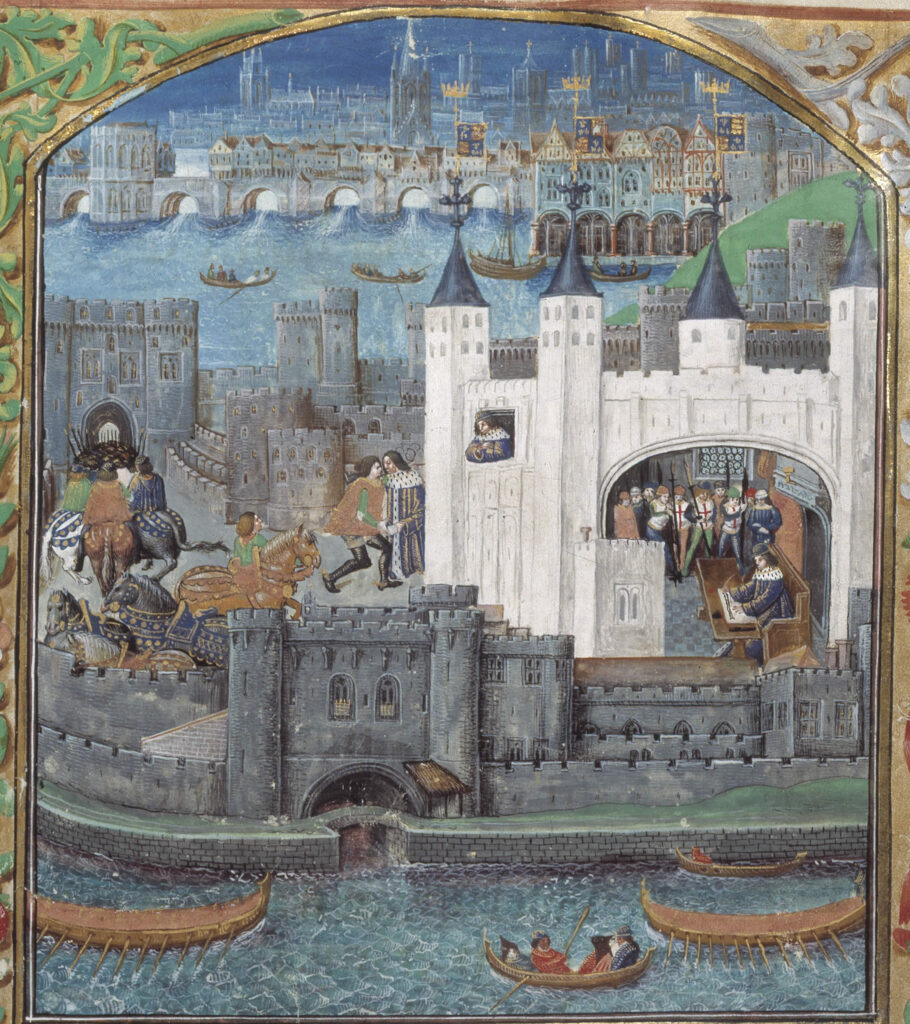
Shorter Fiction · Historical Fiction · The Peasants’ Revolt, 1381
The Open Gate
A Short Story of the Tower of London, 12–15 June 1381
This is a work of fiction set inside documented events. June 1381: the rebels walk into the Tower of London and nobody fires a shot. For one archer, the day turns on whether he tells his own brother where the Archbishop is.
A note on what is record and what is invention follows the story.
Wednesday, 12 June
Hugh Marden had walked the wall of the Tower for six years, and in that time his worst enemy had been the damp.
That was what the place was for. King Henry had thrown a wall around the Conqueror’s old keep. His son, the first Edward, had thrown a second around the first, with a moat outside both and a western approach so thick with barbican, bridge and gate that any man meaning harm to the king would have to fight through three defences before he saw the White Tower. The garrison called it the safest place in England and the dullest. Hugh had never been sure which they meant as the compliment.
On Wednesday the news came up the river with the ferrymen, and it was not dull.
Kent had risen. Not a village, not a manor: a shire. They had been at Rochester and Maidstone and Canterbury, and they had opened the prisons and walked the prisoners out into the daylight. Now they were camped on Blackheath, a morning’s walk from the Bridge. The ferrymen said thousands, then said it again, as if they had heard themselves and did not care for the sound.
Hugh was from Marden, in the Weald. He had not been home since the year he took the king’s pay. His brother Ralf held nine acres there and a share in a plough-team. Every Michaelmas Hugh sent what he could spare, and every Michaelmas the carrier came back with no message at all, which was Ralf’s way of saying received. The poll tax had put a price on every soul over fifteen. Hugh, who knew his brother, would have wagered a month’s pay that Ralf’s eldest girl had been counted as fourteen for the last two winters.
Serjeant Croke found him at dusk.
“Orders. Nobody looses a shaft without the Constable’s word. The Constable takes his word from the council, and the council, God help us, takes its word from a lad of fourteen who’s never been shouted at by anyone he couldn’t hang.”
“And if they come to the gate?”
“Then we’ll find out what the council thinks,” said Croke, and spat over the parapet.
Thursday, 13 June: Corpus Christi
The bells were still ringing for the feast when the king went down to the water.
Hugh had the river stair that morning, so he saw all of it. There was the royal barge with its pennons, and the lesser boats packed around it. The Archbishop was aboard, and the great lords with him. The boats pulled downriver toward Rotherhithe, where the boatmen said the whole of Kent had come down to the bank to see its king.
They were gone about as long as a long Mass. When the barge came back the oars were slack and the company looked exactly as it had on leaving. Nobody had gone ashore. The king came up the stair very straight, as a boy does who has been told to and knows he is watched, and passed Hugh without seeing him.
The rest of the day reached the Tower in pieces. By then Southwark’s prisons were open and the Archbishop’s house at Lambeth had been broken into. Then, as the light went, the worst piece: the Bridge had been opened to them from inside, and Aldgate too. Some Londoners wanted the rebels in and some were only afraid, and no one on the wall could tell which was which.
After dark Hugh climbed to the wall walk and looked west. Upriver, low and orange, there was a glow where no glow had any right to be. It was the Savoy, the Duke of Lancaster’s great house. It would be said afterwards that they burned it and stole nothing, and that they threw one man who pocketed a silver cup into the flames for his trouble. Hugh knew only that the fire was very large and that nobody was going to put it out.
Croke came and stood beside him.
“They’ve a list,” he said. “Half the names on it are sleeping inside these walls tonight.”
He did not say the rest, and Hugh did not ask.
Friday, 14 June
The king rode out that morning to meet the Essex men at Mile End, with a small train of lords and knights. A boy of fourteen going out into a crowd to hear what it wanted. Hugh would never decide whether that was courage or the last idea the council had left.
The Archbishop did not go with him. He stayed, and went into the chapel. Hugh heard three different reasons for it before the day was out, none from anyone who would have known.
The Kentish men had not gone to Mile End either. They came to the Tower.
Hugh was in the outer gate when the sound reached him. It was not the roar he had braced for but a low, steady noise, like a mill-race in spate. Then the front of them came into view along the roadway, and what struck him was how ordinary they were. There were carters and smiths, a miller still in his apron, and boys with staves and old bills and a few hunting bows. There were women too. He had been trained for an army. This was a parish.
They had a challenge they had been shouting at everyone they met along the road, and it came across the ditch now. With whom do you hold?
The answer came back from the wall above him, in Croke’s voice, flat and deliberate: With King Richard and the true commons.
Who gave the word to open the gate, Hugh never learned. It came down the stair without a face, and was obeyed. Nobody loosed a shaft. That was the thing he would try to explain afterwards, to the people who always asked. Some wanted to know whether the garrison had been cowards, and some whether it had been traitors. There were archers enough on those walls to make that roadway a slaughterhouse. Everyone on the wall knew it, and in the first moment so did the men below.
They came in quiet, the way men enter a church. They stared up at the height of the walls, then at the bowmen along them, then at each other. The bows had been lowered. Hugh could not have said who lowered the first. He only saw that they were down.
Hugh saw Ralf four or five strides into the gate. He was broader than Hugh remembered, burned dark by a thousand days in a field, with a long hedging-bill over his shoulder. He stopped, and the crowd parted around him like water round a post.
“Hugh.”
“Ralf.”
Ralf looked at the coat on his back. “You’re in the king’s coat.”
“I’m in the king’s pay.”
“That’s not the same thing,” said Ralf, not unkindly. Hugh found he had nothing to say back, because it was true, and because he had spent six years hoping nobody would ask.
“Where are they? The archbishop. The treasurer. You’ll know.”
He did know. He had watched the old man go into the chapel that morning. For the length of a breath he stood with the whole matter in his mouth.
“I know nothing of it,” he said.
It was the first lie he had told in the king’s service, and it lasted about as long as a lie can with a hundred men behind it looking for the same answer. Somebody else said, “The chapel,” a groom or a kitchen hand, Hugh never saw his face. Then Ralf was gone into the press, and the sound changed.
They brought the Archbishop out through the gate. Simon of Sudbury was an old man, older than Hugh had thought. He walked between the men who held him with his head up, as though the road to Tower Hill were a procession. They took the Treasurer too, and a king’s serjeant, and a friar who was the Duke’s physician. It was not a long way. Hugh could hear the crowd for most of it. It took more than one blow, and he heard them counting. After a while he stopped hearing it and simply stood, as the whole garrison stood, holding a bow he had not been told to use.
Behind him the Tower was being walked through like a house after a death. Men went up through the royal chambers. Some would say later that they lay down on the king’s own bed and laughed, and others that they never touched it. Men who were not there would later tell it each their own way.
What Hugh saw was the king’s mother, carried down toward the river.
Croke had sent him to the water stair. He got there as the women came down the steps with the Princess between them, white as tallow, her eyes shut. A boat was waiting. Hugh went into the river to his knees and held it against the stair with both hands until they had her in and the oars were out. It slid away into the tide toward the King’s Wardrobe.
It was, he thought afterwards, the only thing he did that day he could have told his brother about without shame.
Saturday, and after
On Saturday the king rode out again to meet the commons, at Smithfield, and Wat Tyler, the man the Kentishmen followed, was cut down in front of them. By evening the crowds were thinning, walking home with parchment in their fists, the charters granted in the king’s name.
Within three weeks the king would declare those charters void.
On Sunday Croke said any man with a mind to could walk to the Bridge. Some wanted to and some did not. Hugh both wanted to and did not, and went.
He walked its whole length with his eyes on the cobbles. At the far gate he made himself look up. The heads were there, new-set on their poles, and he looked at each of them slowly, the way you count sheep.
Not one was his brother’s.
It was the only news the Tower would give him, and it was not the same as good news. He walked back the way he had come and climbed to the wall. The Tower had held, which was what it was for. He had never before understood how little that word covered.
A note on the history
The Open Gate is fiction set inside documented events. Hugh Marden, his brother Ralf and Serjeant Croke are invented, and so are the order to open the gate, the lowered bows and Hugh’s part in getting the Princess to the boat.
The frame is drawn from the record: the king and his council in the Tower, the barge to Rotherhithe on Corpus Christi, the opening of London Bridge and Aldgate, the burning of the Savoy, the entry to the Tower while the king was at Mile End, the killing of Archbishop Sudbury and others on Tower Hill, Smithfield, and the later revocation of the charters.
The accounts agree that the rebels got into the Tower without a fight. They do not tell us why, and the story does not claim to. On other details the accounts differ, including who was aboard the barge and exactly where Sudbury was seized, and the story avoids committing to them.