Anglo-Welsh border · Early medieval · In progress
The King’s Crossing
The due is the due — until the law has nowhere left to stand.
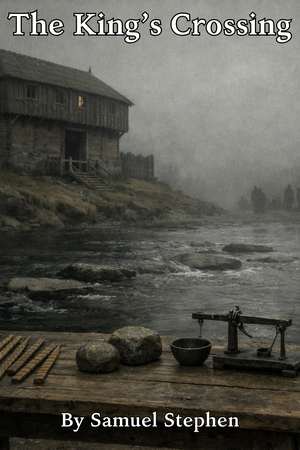
A toll-house on a border river. Leofwine keeps the king’s crossing with a reeve named Ælfric, weighing silver, cutting tallies, holding a line that has started to bend under pressure no one will name. Then, one morning, the toll-house door is open when it shouldn’t be.
This is a work in progress — the opening chapters are below.
CHAPTER ONE: THE SOMERVILLE TALLY
The river ran low for the season, not shallow enough to make a man careless, but low enough that the stones at the ford showed their backs like the knuckles of an old hand. On the Mercian side, the track widened into trampled mud where wheels had cut it down to clay. On the Welsh side, the bank lifted more steeply, tufted with grass and broom, the path narrowing into the scrub.
Leofwine stood where he always stood when he wanted to see without being seen — one pace back from the waterline, close enough to hear the cattle breathe, far enough that no man could claim he had been in their way.
The toll-house sat on the rise, timbered and squat, a roof of split oak darkened by years of smoke. A fence of sharpened stakes enclosed a yard with a gate wide enough for a cart. Beside it, a post bore the king’s mark cut into the wood: a sign that the crossing was not merely a piece of river but a place of due.
Ælfric had been there since dawn. He was not a tall man, but he filled the space around him with order. His hair was bound back with a strip of leather. His cloak was plain, his knife good. When men wanted to argue, they argued with him first, and when they wanted to pretend they had not understood, he repeated the numbers without changing his face.
On the bench inside the toll-house lay the tools of the day: a bundle of tally sticks — fresh-cut hazel for new counts, older notched pieces dark with handling — an iron pin for marking, a small weight-stone, and a leather pouch of clipped silver.
Leofwine watched the day begin the way he had learned to watch disputes — by counting what moved, and what did not.
The first traffic was local: a man with a cart of peat, two boys driving pigs, a woman walking with a bundle of rushes on her back. These paid what they always paid: a pennyweight here, a small portion there, or the promise of it recorded against a name. Ælfric marked them, split the tally where it needed splitting, and set the king’s portion aside.
Then the merchants began.
They came in twos and threes, not the great trains that arrived with banners and a man paid to speak, but smaller groups, moving quickly, keeping their eyes on the river and the far bank. Some were Mercian, men with clean-shaven cheeks and belts worn smooth. Some were Welsh, hair longer, cloaks pinned differently, knives carried with an ease that was neither threat nor reassurance.
Leofwine did not call them Welsh aloud. He did not call them anything. Names, he had found, made men choose sides before there was need.
A packhorse splashed through first, its load wrapped in oiled cloth. Behind it came a cart with two barrels bound in rope. The driver’s hands were red with cold.
Ælfric stepped forward, the tally in his left hand.
‘Goods?’
‘Salt,’ the driver said.
‘From where?’
‘From the west.’
‘Salt from the west still counts as salt,’ Ælfric said. He lifted the cloth at the edge of the load with the iron pin, enough to see the pale crust at the rim of a sack. He did not dig. He did not need to. If the sack held stones, the man would be caught later, when his customer complained or when the king’s reeves counted the shortfall. The toll-house did not exist to prevent all deceit. It existed to record it.
Ælfric named the due without raising his voice.
The driver fumbled in his pouch and produced a clipped piece, too small by half. He held it out as if offering a kindness.
Ælfric did not take it.
‘The due is the due,’ he said.
‘It’s a hard season,’ the man said.
‘It is the king’s season as well as yours.’
The driver’s face tightened. He glanced past Ælfric towards Leofwine, measuring the distance between complaint and advantage.
Leofwine stepped forward, not quickly, not slowly, and the glance dropped.
‘What you owe is written before you arrived,’ Leofwine said. He did not say it like a threat. He said it like weather. ‘If you cannot pay it today, you do not cross today.’
The driver hesitated, then produced another clipped piece, and then another.
Ælfric weighed them against the stone, nodded, and notched the tally.
The cart rolled on.
By midmorning, the pattern was established. The traffic was heavier than it should have been for the season, but the silver was thin. Men paid late. Men argued the count. Men offered part now, part later, as if the toll were a neighbour’s favour rather than the king’s due.
Ælfric brought the tally to Leofwine once, at the pause between groups, and held it out.
‘How many?’ he asked.
‘More than last week,’ Ælfric said.
‘And the silver?’
Ælfric opened the pouch. Inside were clipped bits, worn and narrow, some so small they looked like filings.
Leofwine’s gaze stayed on them a moment too long. Not anger. Calculation.
‘Are they clipping on the road,’ he said, ‘or bringing clipped silver from the start?’
Ælfric shrugged, a movement that carried no ignorance and no excuse.
‘They say what men always say,’ he replied. ‘That it’s all they have.’
By which he meant more traffic, less payment.
Leofwine looked out across the river. He said, ‘From tomorrow, we fine them.’
Ælfric did not argue. ‘They’ll dispute it,’ he said.
‘They can dispute it with the mud,’ Leofwine replied, ‘or with the river.’
The afternoon traffic began again, smaller now. The work resumed in the same rhythm: question, answer, count, notch.
Leofwine returned to his place near the waterline. He watched the next cart roll down the track towards the ford. The wheels sank into the rut and lifted again. The oxen lowered their heads and pushed into the current.
The river took the cart the way it took everything: without opinion, without haste, and without pause.
CHAPTER TWO
The court mound was already worn smooth by boots when Leofwine arrived, though the sun had only just cleared the eastern bank. Two disputes had been settled there since first light, both small, both ordinary. Neither required judgment. Both required time.
Ælfric had the tallies laid out on a plank, sorted by notch and cut. ‘They argue more,’ he said, not looking up.
‘They always argue,’ Leofwine said.
Ælfric nodded. ‘They argue longer.’
That was true. The disputes no longer ended with the count. Men leaned in closer, asking to see the stick again, asking which cut had been made at which hour, whether the weight-stone had been dry when the silver was tested. None accused the toll-house of theft. They asked for repetition.
By midmorning the plank was crowded with sticks. ‘We will need another table,’ Ælfric said.
‘For what?’
‘For the counts waiting to be checked.’
A pair of Welsh traders crossed together, their horses roped flank to flank. They paid without delay, but watched the counts from the corner of their eyes. When they were done, they did not leave. They stood by the water, speaking quietly to each other until a third man joined them from the road.
Leofwine noticed, and made no comment.
In the afternoon, a horse stumbled on the stones and had to be led clear. A man from the line complained that he had already waited since dawn. Ælfric marked the time on a fresh stick, cut shallow, then deeper, to show the passage of the hour.
When the last count of the day was finished, the tallies were bundled and carried into the toll-house. Ælfric closed the door and leaned his head back against it.
‘We can keep this pace,’ he said.
Leofwine looked at the bundles on the table, the cord stretched tight around them.
‘We must,’ he said.
Outside, the river went on running, unchanged, carrying what it carried past the stones and out of sight.
CHAPTER THREE
The toll-house smelled of wet wood and old smoke.
Leofwine woke before dawn, as he always did on court days, and lay for a moment listening to the river. The sound was steady. The ford would be passable. There was no wind.
He dressed in the half-light, pulled his belt tight, and stepped outside.
The door was open.
It was not hanging wide. It had been pulled back and left. The latch sat where it should, lifted but not broken. The threshold was empty.
Leofwine stood still long enough to be certain the emptiness was real. Then he crossed the yard and went in.
Ælfric lay on his side in the corner by the tally table, his legs folded in an awkward angle as though he had tried to turn and failed. The back of his head was dark. The floorboards beneath him shone wetly where the blood had soaked into the grain.
The silver tallies were gone.
The plank table had been dragged away from the wall. The chest under it was open, its lid tilted back.
Leofwine knelt beside Ælfric and touched his neck with two fingers. The skin was already cooling. The body was slack. There was no breath.
He stood up and went outside.
The yard was empty. The riverbank was empty. The first light showed no movement on the road.
He sent word to Wulfmær: come now, and bring men who can stand.
When Wulfmær arrived, he brought three men with him, all armed with tools rather than weapons. Their faces were grey with sleep. They stopped at the threshold and stared into the room.
‘Who did it?’ Wulfmær asked.
‘We do not know,’ Leofwine said.
‘They took the silver.’
‘Yes.’
‘Then it is theft.’
Leofwine walked past him into the yard.
‘It is theft,’ he said. ‘And it is a killing.’
He gave orders, and they were obeyed because there was nothing else to do.
‘Do we close the ford?’ Wulfmær said.
Leofwine looked at the river. The stones lay in their place. The current ran as it always ran. The crossing was still a crossing.
‘No,’ he said. ‘We do not close it.’
‘Why not?’
‘Because the king’s due is still due,’ he said. ‘And because a killing does not make the law disappear.’
‘It makes men afraid,’ Wulfmær said.
Leofwine said nothing. He went back inside.
He did not cover Ælfric. He did not move him. He left him as he had fallen, because to disturb the body before witness was to invite dispute.
The first cart reached the bank. The driver looked at the open door, the men standing with tools, the stillness that should have been movement. He slowed the horse.
Leofwine stepped forward into the space where Ælfric would have stood.
‘The toll is taken as normal,’ he said. ‘You will pay, and you will cross.’
The driver stared at him as if he had not understood the words. Then he nodded, reached into his purse, and held out the coin with a hand that shook slightly.
By the time the elders arrived, the line had formed. The ford was working. The table was running. The day had begun.
Inside the toll-house, Ælfric lay in the corner, cooling in the dimness, while the river continued its steady sound outside, indifferent to tallies and blood alike.
No answer came with the dark.
And none was expected yet.